Oslo Amateur Radio Group achieves world’s first voice control of a satellite!
For the first time in history, a satellite had successfully responded to a spoken voice command, and it was accomplished by members of the Oslo Amateur Radio Group (LA4O), part of the Norwegian Radio Relay League (NRRL – the national non-profit organization for amateur radio enthusiasts in Norway).
The command was transmitted on the 23 cm amateur radio band from the rooftop of the group’s club station at Rommen in Oslo and received by the European Space Agency’s OPS-SAT PRETTY satellite.
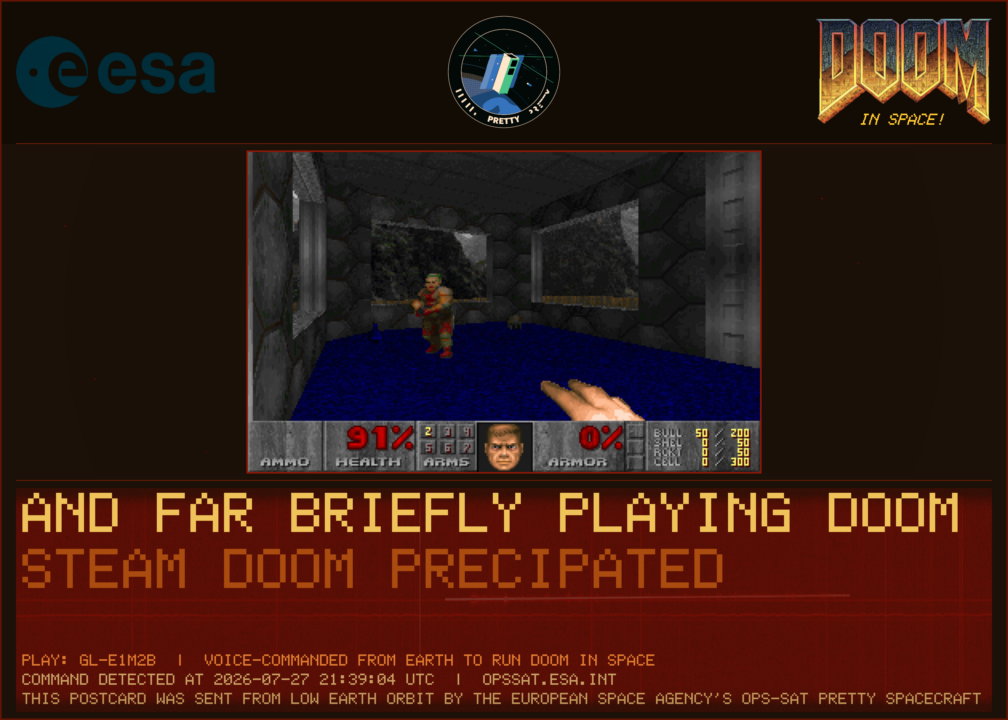
The achievement has since attracted international attention. In October 2026, Tanagra Space published an official press release documenting the experiment and its significance for future space missions.
The Satellite: OPS-SAT PRETTY
OPS-SAT PRETTY is a 3U CubeSat measuring approximately 10 × 10 × 34 cm. It features a reconfigurable onboard processing platform that enables a wide range of software and firmware experiments, closely integrated with an onboard software-defined radio (SDR).
The spacecraft provides a platform for government agencies, research institutions, and commercial organizations to conduct experiments in orbit. It is operated by Graz University of Technology (TU Graz), while experimental activities are coordinated by the European Space Agency’s European Space Operations Centre (ESOC) in Darmstadt, Germany.
This flexibility would prove essential to an experiment that had never been attempted successfully before.
How It All Began
The project began with an unexpected inquiry through the Oslo Amateur Radio Group’s website.
At 23:34 on May 29, 2026, we received a message from Ólafur Waage, an Icelandic software developer based in Norway who had previously worked with the European Space Agency (ESA) on the OPS-SAT programme.
The following evening, the message was forwarded to the club’s board by our secretary, Nina (LB7SJ), who observed that it was an interesting proposal and suggested that someone might want to take advantage of the opportunity.
Ólafur’s message outlined a rather unusual idea.
The ESA team had already succeeded in running the classic video game DOOM aboard OPS-SAT-1, first in late 2023 and later, in 2024, using photographs of Earth captured by the spacecraft itself as imagery within the game.
However, OPS-SAT PRETTY had one important advantage: it was equipped with radio hardware that could receive audio signals.
In other words, the satellite could listen.
That capability opened the door to a new experiment. Amateur radio operators could transmit a spoken message to the spacecraft, and the spacecraft could interpret the message and act upon it.
As Ólafur Waage put it:
«It would be very fun if Norwegian radio amateurs were the first to call up to a satellite and tell it to play DOOM.»
The Oslo Amateur Radio Group replied shortly after midnight on June 1, noting that several club members were already active in satellite communications on S-band and lower frequencies. As a result, assembling the necessary equipment seemed manageable.
A board meeting was already scheduled for the following evening, and Ólafur was invited to join by video call.
The board agreed to participate.
Eight weeks later, his proposal had become a reality.
Building a Ground Station to Talk to a Satellite
The primary objective was to launch DOOM aboard OPS-SAT PRETTY in response to a spoken command transmitted by the Oslo Amateur Radio Group.
Several supporting objectives were also identified: building a 23 cm uplink station, investigating problems encountered during previous audio transmissions to the spacecraft, validating improvements to audio capture and processing, and developing procedures that future experiment teams could reuse.
It took just 59 days from the initial inquiry to the successful execution of DOOM aboard OPS-SAT PRETTY on July 27, 2026.
This was accomplished despite delays in antenna deliveries, a period of public holidays, and summer vacations for most of the participants.
The Oslo team assembled a ground station using the following equipment:
- Transceiver: Icom IC-9700
- Power amplifier: PE1RKI XRF286S LDMOS amplifier
- Power supply: 28 V
- Amplifier control: Manual bias controller
- Power meter: Komunica SX-1000
- Antenna: Wimo Helix23-2, 15.1 dBi RHCP (right-hand circular polarization)
- Uplink frequency: 1296 MHz FM
Four synthetic voices were prepared by Eskil (LB6AJ) and stored on a memory card, allowing the recordings to be transmitted through the IC-9700’s built-in voice keyer.
The station was now ready to transmit commands to a satellite hundreds of kilometres above Earth.

July 27, 2026: The First Successful Voice Commands
Two satellite passes were used on July 27, 2026.
First Pass: 12:51 CEST
During the first session, the team transmitted continuously throughout the satellite pass using the voice keyer.
The station operated with approximately 5.5 A indicated and an RF output power of around 80 W, as measured on the power meter.
Shortly afterwards, the team received an excited response from Tanagra Space:
«Oh my God, IT WORKS!»
Recordings 1, 4, and 5 had successfully triggered the command, causing the satellite to launch DOOM.
The experiment had succeeded.
For the first time, a satellite had received a spoken command over a radio link, interpreted it, and carried out the requested action without human intervention aboard the spacecraft.
But the team wanted to take the experiment one step further.
Second Pass: 23:37 CEST
During the second satellite pass that evening, the synthetic voice recordings were replaced by a human operator.
Jon (LB9BJ) spoke the command directly into the microphone from the rooftop ground station in Oslo.
The station again operated at approximately 5.5 A and 80 W indicated RF output power.
The spacecraft’s attitude control system had not been activated, meaning the planned Earth-pointing orientation was never achieved.
Fortunately, the satellite’s orientation was nevertheless suitable during parts of the transmission.
One of the recordings successfully captured and interpreted Jon’s spoken command, launched DOOM, and correctly recognized the command keyword twice.
Jon (LB9BJ) of the Oslo Amateur Radio Group had become the first person in the world to successfully control a satellite using a live spoken voice command!
The experiment demonstrated that amateur radio infrastructure can support technically significant spacecraft experiments when RF engineering, signal processing, onboard software, and disciplined operating procedures are treated as parts of one integrated system.
International Cooperation Made It Possible
The project was the result of close cooperation between amateur radio operators, software developers, and professional space operations teams.
Ólafur Waage coordinated the collaboration between the Oslo Amateur Radio Group, Georges Labrèche and Tanagra Space, and the teams at ESA and TU Graz.
The Oslo Amateur Radio Group provided the ground station and contributed extensive signal analysis.
Georges Labrèche of Tanagra Space reproduced the proposed approach to narrowing the receiver bandwidth, integrated the changes into the spacecraft’s processing pipeline, and tested candidate commands against the onboard executable.
ESA scheduled the experimental windows and provided spacecraft status reports.
This rapid exchange of technical findings allowed each satellite pass to serve as an engineering experiment rather than simply a success-or-failure event.
The collaboration demonstrated what can be accomplished when volunteer amateur radio operators and professional space engineers work together.
Why Is This a World First?
What makes this experiment different from the earlier DOOM demonstration aboard OPS-SAT-1 in 2023 is not the video game itself, but the way it was launched.
By 2026, speaking a command aloud and having a remote computer respond has become an everyday experience on Earth.
Voice assistants such as Amazon Alexa and Google Assistant respond to spoken wake words in millions of homes. The same interaction model is used to control lighting and heating, dictate and send text messages, and enter destinations into vehicle navigation systems.
A wake word followed by a command is something most people now use without giving it a second thought.
OPS-SAT PRETTY implemented precisely this interaction pattern, using the words «PRETTY» and «DOOM».
Satellites, however, are normally controlled using structured, preformatted command files uplinked during scheduled communication passes.
This experiment took a fundamentally different approach.
Instead of receiving a traditional spacecraft command, the satellite listened to a human voice transmitted over an ordinary amateur radio link.
It then processed the audio, recognized the spoken instruction, and executed the requested action autonomously while in orbit.
Without a human operator in the onboard processing loop, the satellite:
- Recorded the radio transmission from the Oslo Amateur Radio Group.
- Separated the spoken voice from background noise.
- Used artificial intelligence-based speech recognition to transcribe the audio into text.
- Identified the spoken command.
- Launched the original 1993 video game DOOM aboard the spacecraft.
- Transmitted a commemorative «postcard» image documenting the historic moment back to Earth.
This was the first successful demonstration of a satellite receiving, understanding, and acting upon a spoken voice command.
The implications extend far beyond playing a video game in space.
The experiment showed that reconfigurable satellites can be equipped with software capable of recognizing and interpreting signals that are not defined in advance as precise digital command sequences.
Such capabilities could eventually be applied to other types of radio signals, enabling spacecraft to identify important events and react autonomously without waiting for instructions from ground control.
The Oslo Amateur Radio Group Team
The following members of the Oslo Amateur Radio Group participated in the project:
- Eskil – LB6AJ
- Jon – LB9BJ
- Magne – LB5SK
- Peter – LA7WRA
- Truls – LA7IJ
- Jan Olav – LB0PI
- Lewi – LA4CIA
- Per Thomas – LB2KK
Acknowledgements
The Oslo Amateur Radio Group would like to thank all the amateur radio operators who contributed to this remarkable project.
We extend our gratitude to Ólafur Waage for approaching us with the idea and inviting us to participate, to Georges Labrèche and Tanagra Space for developing and operating the onboard experiment together with Waage, and to ESA and TU Graz for giving us the extraordinary opportunity to transmit commands to their satellite.
We would also like to acknowledge the contributions of amateur radio operators SQ6RDP and SQ6QV in Legnica, Poland, who participated in the experiment before us.
The project demonstrates what can be achieved through curiosity, technical experimentation, international cooperation, and the volunteer spirit of amateur radio.
International Coverage and Further Reading
The experiment has received international attention, including coverage by the American Radio Relay League (ARRL) and an official press release from Tanagra Space.
The following resources provide additional information about the experiment, its technical implementation, and the results.
Official Press Release – Tanagra Space
First Voice Command of a Satellite Achieved Through ESA’s OPS-SAT Space Lab
Tanagra Space’s official press release, published in October 2026, documents the achievement, the international collaboration, and its significance for future autonomous spacecraft operations.
https://tanagraspace.com/press/first-voice-command-of-a-satellite
LA4O Technical Report
Oslo Amateur Radio Group – Technical Campaign Report
Eskil (LB6AJ) has prepared a comprehensive technical report covering the Oslo team’s participation, including the ground station, radio equipment, signal analysis, experimental procedures, and results.
Additional photographs and documentation are also available.
Georges Labrèche – Technical Account
Georges Labrèche, who developed and operated the onboard experiment, has published a detailed account of the project.
Ólafur Waage coordinated the collaboration and developed the game code used in the experiment.
This account includes the actual audio recording of the voice command as received by the spacecraft, recovered from radio signals approximately 500 kilometres above Earth.
https://georges.fyi/opssat/first-voice-command-of-a-satellite
Tanagra Space – Project Page
Tanagra Space’s project page documents the experiment from beginning to end, including the commemorative postcard generated aboard the satellite and the gameplay sequence captured while it was orbiting Earth.
https://tanagraspace.com/opssat-pretty-doomed
American Radio Relay League (ARRL)
The experiment was featured in The ARRL Letter, published on August 6, 2026.
https://www.arrl.org/arrlletterissue?issue=2026-08-06
Photographs and Media Enquiries
Additional photographs from the experiment, complete with captions and descriptions, are available at:
Journalists, publishers, and other media outlets wishing to reproduce or use these photographs are kindly requested to contact the Oslo Amateur Radio Group (LA4O) at lb6aj@la4o.no before publication.
Please include the intended publication or use in your enquiry.
About the Oslo Amateur Radio Group
The Oslo Amateur Radio Group (LA4O) is a local group of the Norwegian Radio Relay League (NRRL), Norway’s national amateur radio organization.
Based in Oslo, the group brings together amateur radio enthusiasts with interests ranging from traditional radio communication to modern digital technologies, satellite operations, electronics, and technical experimentation.
The group promotes amateur radio through training, practical activities, and cooperation between radio amateurs of all experience levels.
For more information, see https://la4o.no/.
Translation Notice
This article has been machine-translated from Norwegian into English and edited for clarity and readability.
The original Norwegian article, published by the Oslo Amateur Radio Group, is available here:
Oslogruppen utfører verdens første stemmestyring av en satellitt!